Ladies Homestead Gathering

I have been leading the Doylestown, PA chapter of the National Ladies Homestead Gathering for a year and we have outgrown my house! A few weeks ago we did a canning demonstration at the Doylestown Farmer’s Market which was a great success. We used an induction burner to boil water for canning and prepared a fresh-fruit + simple syrup recipe for the market shoppers, which we sold for a fundraiser. Blueberries & Bay is one of the easiest canning recipes I’ve ever done, and the result is simple and yummy (see recipe below).

We talked to lots of people about our group, but the luckiest moment of the (very hot!) day came when we met Shawn Touhill of Sandy Ridge Farm and Market. He and his wife are the newest full-time farmers in Doylestown, and have generously offered to host our monthly Gatherings in the Community Room of their Farm Market! The market is a great fit for our group, and will give us the space we need to meet comfortably and to grow our Gathering. You can read more about the Touhill Family and Sandy Ridge Market here.

In addition to hosting our monthly Gatherings and any workshops we decide to do this year, Shawn is a great resource for farm-to-consumer marketing and I hope to learn much more about his business as a potential model for our own farm.

In other news: We are back on realtor.com every day searching for potential properties. We are feeling a new sense of urgency that has us buckling down on the small house renovations, and hoping to sell within the next year. We’ve looked all over, and currently our search is centered around Madison County, Virginia because it’s halfway between Gramma’s house and Grampa’s house, and because it borders the Shennandoah National Park and other preserved land. I’ve been doing some asking around and it seems like Madison County (or neighboring Rappahanock County) would be a good fit for our farmy family, so we’ll see!

Blueberries & Bay

Blueberries & Bay Canning RecipeIngredients
Approximately 3 quarts fresh or frozen blueberries
5 cups water
2 cups sugar
Bay leaves

Equipment
Waterbath canner
Jar lifter
Lid lifter
Ladle
Canning jars, sterilized
Unused canning lids
Canning jar rings

Directions

  1. Place canning lids in heat-safe pot or bowl and cover with boiling water to sanitize and soften the gum. Fill the waterbath canner and bring to a rolling boil.
  2. Heat water to boiling and add sugar, stirring to dissolve. Boil for 5 minutes and set aside. Place blueberries and one bay leaf into jars, leaving ½” headspace. Ladle hot syrup into jars, maintaining ½” headspace. Remove any air bubbles from jars before wiping the rims with a warm, damp dishcloth.
  3. Add lids and attach rings – tighten just until you feel resistance.
  4. Place jars into canner, insuring they are covered by at least 1” of water. Bring to a rolling boil and begin timing: 15 Minutes for ½ Pints and Pints; 20 Minutes for Quarts
  5. Carefully remove jars from canner and allow to cool on a towel-lined countertop.

Now, with your canned blueberries, you can make muffins, syrup, or just eat them on top of cereal, ice cream or yogurt. Enjoy!

What’s in Season in July? Zucchini!

growing-zucchini-how-to-grow-zucchini-summer-squash2Someone I know said “We’re not even growing any zucchini in our garden this year!” because it is so very prolific and some members of her family aren’t big fans. Zucchini definitely grows well, but it is also incredibly versatile in the kitchen, playing the lead role in savory dishes as well as sweet ones. It can be cut and roasted or sautéed, baked into breads, used as a pizza topping or even made into noodles and eaten like spaghetti!

Even the blossoms of this large plant are edible! If you decide to harvest them, make sure you grab only the male blossoms, saving the females to grow the fruit!

zucchini blossoms male female

Thinking about growing zucchini in your garden?

Soil preparation: Zucchini likes well-drained, fertile soil that’s been amended with lots of compost.

Planting: Plant seed outdoors when the soil temperature has reached 60°F—about a week after the last frost.

Spacing: You want to give your squash a lot of room to spread out and grow. Plant them about 3 to 4 feet apart in rows 8 to 12 feet apart.

Watering: Zucchini like consistently moist soil. To prevent problems with disease, always water from below.

Fertilizing: Spray plants with compost tea two weeks after seedlings come up. Spray again in three weeks or when the first flowers appear.

Special hint: If space is limited, put up a trellis for vertical support.

Pest Watch 
Pale to brown blotches on leaves are the work of squash bugs. Squash vine borers cause plants to wilt suddenly.

Disease Alert 
Powdery mildew may strike the plants, leaving whitish powdery spots on leaves that turn brown and dry. Plants that wilt and ooze a sticky sap when cut may be infected with bacterial wilt, which is spread by cucumber beetles.

Harvesting 
Harvest zucchini when the fruits are still small—about 3 to 4 inches across or 4 to 6 inches long. You can store zucchini in the refrigerator for about a week.

Source: http://www.organicgarding.com

Need a recipe?

This recipe came from a member of the CSA for which I work. It comes with such a high recommendation it’s the first recipe I’m sharing that I haven’t prepared myself yet!

Zucchini Cobbler

photo credit: dazzledish.com

Ingredients

Fruit
8-10 cups zucchini, peeled, cubed and seeded
1 cup sugar
2/3 cup lemon juice
2 tsp. cinnamon
½ tsp. fresh nutmeg

Cobbler
4 cups all-purpose flour
2 cups sugar
1½ cups chilled butter
2 +/- tsp. cinnamon
1 cup granola or oats (optional)

Directions

1) Place the prepared zucchini in a bowl with 1 cup of sugar, stir frequently and let sit until the water is drawn out of the zucchini and a syrup has formed (this process can take a few hours or it can sit over night).

2) Add lemon juice, cinnamon, and nutmeg. (If you’re in a hurry, you can expedite by cooking the zucchini, sugar, lemon juice, cinnamon, and nutmeg.)

3) In a separate bowl: mix flour, the remaining 2 cups of sugar, and butter. Blend together using a pastry knife (or butter knife).

4) Mix 1/2 cup of the pastry mixture in with the zucchini as a thickener and place 1/2 of the remaining mixture in the bottom of a greased baking dish. Use your hands to press it into the dish to form a crust.

5) Pour the zucchini mixture on top of the crust. Add to the remaining pastry mixture and your ‘finishing touches’ (cinnamon, granola, oats, etc.). Pour this mixture on top of the zucchini. Place in the oven and bake at 375 for 30-45 minutes.

Recipe: Zuccanoes

This is a yummy, vegetarian dish featuring a prolific summer vegetable we always seem to have too much of… I love this recipe just the way it is though I usually add the cheese halfway through the baking time to minimize burning. Any leftover “filling” is perfect for lunch the next day!

Stay tuned throughout July for some more great zucchini recipes!

Moosewood Zuccanoes
photo credit: thesuechef.blogspot.com

Zuccanoes
from The New Moosewood Cookbook by Mollie Katzen

Ingredients

4 medium zucchini (about 2 lbs)
1-2 Tbs olive oil
1 1/2 cups minced onion
1 tsp salt
1/2 lb minced mushrooms
1 1/2 cups cooked rice
1 1/2 cups minced almonds or pecans (lightly toasted)
3 Tbs fresh lemon juice
Black pepper and cayenne pepper, to taste
A few pinches of freshly minced (or dried) herbs (any combination of parsley, basil, dill, thyme, or marjoram)
1 cup (packed) grated Swiss or cheddar cheese

Directions

  1. Cut the zucchini lengthwise down the middle. Use a smallish spoon to scoop out the insides, leaving a canoe with a 1/4-inch shell. Mince the insides, and set everything aside.
  2. Heat the olive oil in a medium-sized skillet. Add the onion and salt, and saute over medium heat until the onion is soft (5-8 minutes).
  3. Add the minced zucchini innards and the mushrooms. Turn up the heat and cook for about 8 minutes, stirring, letting the liquid evaporate. Stir in the garlic and remove from heat.
  4. Stir in the rice and nuts, along with the lemon juice, and season to taste with black pepper, cayenne, and the herbs of your choice.
  5. Preheat oven to 350 degrees. Fill the zucchini shells, top with cheese, and bake for 30-40 minutes, or until heated through.

Workshop Review: Fermentation Basics

This past weekend I attended a fermentation workshop at Blooming Glen Farm in Perkasie, PA where I knew I would:

Learn the basic principles of this ages-old, simple and fun preservation method by getting hands-on with yogurt, sauerkraut and seasonal vegetables. Everyone will leave with a jar of pickles or kraut and a culture with which to make their own, very simple yogurt at home! You will also leave (hopefully) with an appreciation for the role of the microbes living all around us!

Although I have been making kombucha for a few years, I have never had success with yogurt, pickles or sourdough; three delicious and useful ferments I am determined to master. Amanda’s workshop was just wonderful and because we had so many fresh veggies at our fingertips {thank you, Tricia & Tom!} we all left with a pint of fermented pickles {ready to eat July 7} and some sauerkraut {ready July 21} plus a tablespoon of villi, a 100-year-old yogurt-like culture from Finland.

Amanda of phickle.comIt is clear that Amanda has done workshops like this one before. She was friendly, informative, and answered all of our questions without hesitation. She was engaging and a joy to listen to. I have a tendency to ask a LOT of questions, and I felt like I was in a safe environment, so I went with my gut and asked away; she answered all of them. I even had a follow-up for Amanda today via her Facebook page!

The thing that I already knew that bugged me the most: you can’t use raw milk in dairy cultures because the good bacteria in un-pasteurized milk will actually kill the good bacteria in your yogurt {or kefir} culture. Ultimately, you have three choices for how to deal with that:

  1. Buy pasteurized {but not ultra-pasteurized} milk.
  2. Home pasteurize your raw milk, or
  3. Maintain a mother culture made with sterilized or pasteurized milk to preserve the viability of the culture {www.culturesforhealth.com}.

For now, I am going with #1 – I picked up a half gallon of pasteurized, grass-fed, whole milk today, so we’ll see what happens. I started 1 cup milk + 1 Tbsp. villi starter around 1:30 today, and I have to work all day tomorrow, so I’m hoping that by 5:00pm tomorrow we’ll have some yummy yogurt!

The most memorable thing that I didn’t already know: using whey in your ferments will speed up the process, kicking the good bacteria into hyperdrive. So it might be useful when you want to have pickles for a certain event, for example, or if you’re giving pickles as gifts. But since the one experiment I’ve done with whey yielded less-than-tasty dilly carrots, I wonder if I don’t like the taste or if I messed something else up along the way…?

Overall, it was a lovely afternoon spent with old and new friends and I am re-energized about stepping back into the world of fermentation. Amanda’s workshop made home fermentation seem easy, affordable, and enjoyable, so I look forward to sharing some successes with you in the near future!

What’s in Season?

Each month I will share a little bit about a garden veggie that is in season where I live {Eastern PA}. Some of them I have grown myself, some I have grown at work, but all of them I have cooked and eaten. Look for these at your nearest Farmer’s Market or wherever you buy fresh, local produce!

What’s in season in June? Kohlrabi!

kohlrabi from nuttykitchen.com
White Kohlrabi {photo credit: nuttykitchen.com}

It’s almost summer time, so the Farmer’s Market stands are really starting to fill in. Cool weather means the brassica-family plants (broccoli, cabbage, etc) are still mild and sweet, but as the heat of summer hits, many of these will begin to “bolt,” or direct their energy to growing seeds, rather than developing tender, yummy fruit.

Kohlrabi is a new vegetable to many first-time CSA members and farmer’s market visitors, but its versatility makes it a perfect candidate for culinary experimentation. Delicious raw, pickled, or in stirfrys, Kohlrabi is easy to grow and even easier to eat!

Thinking about growing kale in your garden this year?
Kohlrabi grows in loose, average soil. For a spring crop, direct-sow seeds 4 to 6 weeks before the last average frost; plant ¼ inch deep, 10 seeds per foot. Or start seedlings for a fall crop indoors 6 to 8 weeks before the last average frost. When seedlings are around 4 inches tall, thin plants to (or set out transplants at) 5 inches apart in rows 1 foot apart. Keep plants well watered and free of weeds; put down a mulch to help accomplish both tasks. Cultivate carefully to keep from damaging the delicate, shallow roots. Use young leaves in salads and stir-fries. Harvest immature “bulbs” when they are no more than 2 inches in diameter, cutting the stems 1 inch below the swollen stem. Remove the leaf stems and leaves, and use the remaining stem as you would turnips. Kohlrabi will keep for several weeks in the refrigerator and for several months in a cold, moist, root cellar. {http://www.organicgardening.com/learn-and-grow/kohlrabi-growing-guide}

Need a recipe?
I made these last summer and enjoyed them for many weeks. We eat most of our kohlrabi raw with homemade hummus, but if you’re looking for something a little different, give these yummy pickles a try! This recipe makes one quart of pickles.

fridge pickled kohlrabi and carrots
photo credit: beckyintherootcellar.com

Fridge Pickled Kohlrabi and Carrots

Ingredients:

4 small kohlrabi
2 large carrots
2 Tbsp. salt
1 cup white vinegar
1 cup water
2 Tbsp. sugar
1-1/2 tsp. pickling or kosher salt
3 garlic cloves, roughly chopped
1 tsp. dill seeds
1/2 tsp. brown mustard seeds
6 black pepper corns, crushed

Start by peeling and slicing the kohlrabi. Place in a colander and salt with 2 Tbsp. salt. Allow the kohlrabi to sit for an hour. In the meantime, peel your carrots and cut into sticks. Combine all other ingredients in a saucepan. When kohlrabi is done draining, rinse and pack with carrots into a quart jar. Boil remaining ingredients until all of the salt and sugar are dissolved and pour over carrots and kohlrabi. Cover and allow to cool on the counter then refrigerate. Let this sit in the fridge for two days before jumping in.

The Great Chick Experiment 2013

As you may or may not know, I am an almost year-old chicken owner. As in, I have had chickens in my life for approximately 1 year. I purchased my original brood as day-old chicks from MyPetChicken.com. We have been very pleased with the birds, but since ordering our chicks, I learned that breeding facilities aren’t always the most humane of operations. I will not go into detail here, but let’s just say that when people {like me} request a certain gender of chickens {for us, 4 boys and 12 girls} there ends up being a surplus of chicks, which may or may not be dealt with in a less-than-pleasant way. Read more here if you want the {extremely gorey} details. Anyway, I decided quickly that I would prefer to stay away from commercial hatcheries in the future, and committed to breeding my own replacement hens going forward.

One of our hennies was getting a little nasty earlier this week, pecking my hands and making an odd growling sound when I attempted to remove her eggs, so she seemed willing and determined to sit on a few eggs for a while. Hoping that these are definite signs of “broodiness,” last night I moved our 3 Buff Orpington hens and our Buff Orpington rooster into the Love Shack for a few weeks in semi-solitary confinement.

Here’s my plan:

  1. Isolate the Buff Orpingtons, the breed we have that’s more inclined to WANT to rear a brood of chicks.
  2. Mark a few eggs and leave them in the nesting area for the “broody” henny to babysit. Here’s where it gets complicated. Since we have 2 other not-Buff roosters, I assume the fertilized eggs already inside my Buff hens are…mixed breed chicks. Since I want purebred chicks, I need to wait for the eggs inside to make their way out before keeping any for incubating. I need something for her to do in the meantime, and don’t want the nest to fill up, so there are 4 marked eggs in the nest. I’ll collect everything else for 3 weeks, assuming those are not purebred eggs.
  3. IF a hen is still feeling broody in 3 weeks, she’ll get to sit on whatever eggs are laid by the Buffs in isolation; I think we will shoot for 10 total. If no one wants to sit, I can at least assume that all the eggs inside are purebred, and whenever another one decides to sit, I will stop collecting again immediately.

While I have no experience with this kind of thing, I do have some really great friends around me who are eager to offer suggestions, and I think my plan has a reasonably good chance of success. Luckily, there really is no pressure to have chicks this year. My hens are only going to be one in June, and won’t need replacing until next spring at the earliest. And since I wasn’t sure exactly when to expect the broody behavior to set in, I am a little concerned I may have missed my chance. I think I will isolate the breeding chickens on April 1 next year, hoping to have the 2-3 week mix-breed eggs out before any hennies go broody. And in the meantime, I’ll keep my fingers crossed for a successful chicken mating season!
**I’ll update the post with a picture tomorrow!

Update, April 22nd
First, here’s a picture.Broody Hen

And now an update: I’ve decided to alter my plan a little bit. I began to worry that our hennie wouldn’t still be interested in sitting around to hatch some eggs by the time I had enough purebred eggs for her, especially since now I’m only getting 1/day from my Buff Mamas. {Come to think of it, I wonder if she’s not letting anyone in and they’re laying somewhere else……?} Anyway, I decided to just let her keep the 4 she started with on Thursday night, and hope that she’ll hatch some of them out around May 9 or so. Then, if another hennie decides to go broody later in the season, we’ll already have the Buffs isolated and can have a clutch of purebred eggs for her in no time. At least I hope. We’ll see what happens!

Begging your forgiveness…

I don’t have any excuses other than LIFE. Life has prevented me from sharing it with you. It started with chickens. We have 15. We started with 16, arriving June 11, but one little girl was lost at about 3 weeks. I’m not sure what happened. One day everyone was fine, the next she was sitting very still, and 2 days later she was gone. The surviving 15 grew big and strong and now live outside in a moveable chicken house {“eggmobile”}. We asked for 4 roosters {1 each: Barred Rock, Buff Orpington, Dominique, Rhode Island Red} but it looks like we didn’t get a Rhody. The Barred Rock seems to be the bossman, but after attacking our daughter this weekend, he’s been put on Death Row. I’m still trying to decide if it would be better to eat him or keep him – he’s the largest and the only one that crows. So for now I don’t let the kids in the pen without me, and I’m trying to “train” him {read: putting my boot in his face whenever he comes near me; seems to be working so far}.

The garden was a huge success {for me}! I planted late, due to our move in April, but we were able to get LOTS of cucumbers and zucchinis, crook neck squash, Bennings Green Tint Squash {a scalloped variety}, and Sungold Cherry Tomatoes. I didn’t plant enough paste tomatoes to make anything substantial, and our larger tomatoes {Azoychka and Black Tula} just didn’t produce much. I was proud of the corn {Country Gentleman} until a few stalks broke {?} and I think the poor drainage and maybe poor sunlight of that corner of the garden led to under-development of the kernels. In August I planted kale, chard, kohlrabi, broccoli and cabbage all of which I hope to overwinter as long as possible. I also planted a few lettuces but I plan to harvest them before any significant cold weather. This weekend or next I will be building one or two cold frames to see what I can do with seed through the winter. Fingers crossed!

We are always searching for land and have visited a few more places:
Monterey, VA: Beautiful landscape, growing local food community. Nearly completely land-locked but huge mountainy mountains. Locals are currently driving an hour and a half to Wal-Mart for groceries every week because there is NO grocery store. No Co-Op, No library, No coffee shop. It’s not a tourist thoroughfare by any means and the only hotel in town is literally crumbling. Oh, and the tiny school system (200 kids, k-12) is shrinking, which tells me the town itself is dying. Very sad. With 30 other couples like us it could be saved, but I’m not sure how that happens…
Floyd, VA: We each spent time here before and after we met, and have always loved this little town. Our recent visit was lovely though very short. The land prices are great: $4,000/acre for most properties. Just 40 minutes from my Alma Mater, it’s high on my list of Towns I’d Love to Live In, but it seems like a lot of things we want to do are already being done by other farms in the area. They are even working on opening a heritage skills school with a grant from the government. Sheesh!

I’ve been looking a lot at Nelson County, VA, though we haven’t visited yet. Nelson County borders the Shenandoah National Park/Skyline Drive/Appalachian Trail so many of the properties we’ve found have amazing views. I have a couple good friends in Arrington, VA, so I might be able to gain some credibility in the community more quickly than other places…? Plus, there are three breweries and four wineries on the main highway through the county: lots of great things happening in the area, it seems. Only downside: land prices, still high at $6,000/acre.

The gist is: we’re still looking.

But the greatest news is that I have been working on our Mission/Vision and had two amazing brainstorming sessions over the past weekend. Basically, I’ve figured out how to focus my energy and my seemingly endless list of “what kind of things would I like to do on my farm?” into 6 categories: Food, Health, Family, Community, Spirit and Education.

We will make the connection between people and their FOOD, by building COMMUNITY, nourishing whole body HEALTH, strengthening the bonds of FAMILY, challenging the norms in EDUCATION all while honoring the SPIRIT.

No one part of our mission is more important than the other, so we could just as easily say: We will build COMMUNITY by making the connection between people and their FOOD, nourishing whole body HEALTH, etc, etc.

Owl Moon Farms Mission

And, lest you insist this is too much for one family, have no worries. I am starting to believe the only way to accomplish my dream farm goals is to enlist the help of one, or two, or four other families that share similar dreams. Between the lot of us, surely we can build something amazing. Stay tuned…

What Does Homesteading Mean to You?

For me, homesteading began with food. After reading The Omnivore’s Dilemma by Michael Pollan, all I wanted to do was find, grow and eat local food. I was convinced the only way for my family to eat a grassfed turkey for Thanksgiving was to grow it myself. That’s the moment I became a farmer.

Unfortunately, I was still living smack-dab in the middle of suburbia, so raising livestock just wasn’t an option. While I waited for my farm dreams to come true, I focused my energy on things I could do immediately to feed my family more healthfully, while saving money, so that we could one day be able to live on a farm.

At that time, my oldest child was only a few months old, and we were drinking organic milk and eating organic vegetables, but we were still fully engaged in the industrial food system. I made it my goal to visit the Farmer’s Market every week that summer, and found a wide variety of foods I had never heard of. And boy, was it expensive! I realized immediately that if we were going to be purchasing real food, from real farmers, we were going to have to spend less in other areas of our life to make up the difference. And it was something I was committed to.

That summer was the first time I ever cooked a whole chicken, and after three years I can finally say I feel comfortable with that. We started out roasting the whole bird every time, but I felt we were wasting a lot of meat {not to mention the carcass} so last year I started cutting the bird before cooking it. Now we eat the breasts and tenders one night, the legs another night, and save the carcass for making stock.

The challenge of cooking a real, whole chicken was just the beginning of my journey to homesteading. In the kitchen, we started baking our own bread, making our own jam and apple butter, and eating fresh, local vegetables nearly every night of the week. One way we save money for fresh veggies is pretty simple: we purchase less meat, and instead rely on other non-meat forms of protein, like beans. I now have hundreds of delicious vegetarian recipes that allow my family to enjoy our meals together – and feel satisfied –without eating chicken breasts every night. Those three meals we get out of our Farmer’s Market chicken? They last us three weeks. We limit our dinners out, and buy almost no prepared foods, opting instead to make our own popcorn, rice crispy treats, fruit bars, and more. Making our own food means I know exactly what goes into everything, and allows me to eliminate sugar almost entirely. We don’t buy “instant” oatmeal, and rarely do we buy cereal. Instead we make our own oatmeal, granola, muffins, and scones and spend those dollars we save on pasture-raised chicken eggs which we enjoy almost every other day.

Rather than purchasing canned beans, we buy dry beans in bulk. They’re ridiculously affordable, and really not that hard to prepare, so I feel good knowing my kids are eating organic beans, organic rice, organic barley, and organic oats. We buy bushels of fruit when they’re in season, meaning we pay much less for “low-spray” fruit that was grown right around the corner – which is good for us, and good for the farmer who grew it.

But homesteading means more than just where you shop for groceries. To me, it’s a lifestyle. And what’s interesting is that a lot of our frugal family choices are ecologically-friendly too. We chose cloth diapers for our children because we couldn’t stand to send bags and bags of paper diapers to the landfills where they would never decompose, so we reduced our environmental impact while also saving thousands of dollars in disposable diapers. We use cloth napkins, towels and washcloths in the kitchen. The kids and I use cloth wipes at home, meaning we buy about ¼ the toilet paper we did two years ago. We shop at thrift stores and consignment stores for nearly everything for the kids and myself {My husband works a “real job” so he shops the big sales for his work clothes, or uses Christmas money to purchase new items}. Clothes, shoes, toys, books, canning jars, bookcases – whatever you need, you can probably find it used and for a lot less than what you would pay at a retail store. I still use Amazon for hard-to-find books, but purchase them used whenever possible. We utilize Craigslist for big-ticket items like our {1996 Ford F150} farm truck, our {1974 Massey Ferguson 135} tractor, and the trailer we’re using for our eggmobile. Every purchase is made with re-useability and longevity in mind. I absolutely abhor re-buying things, so I sometimes spend a little more now {say, $30 on a set of enamelware picnic plates} instead of spending more over time for something that will be thrown away.

We try to save money and do-it-ourselves in other ways too. We believe children deserve a better education than what is being offered in public schools today, but the cost of private school is insane, so instead, we plan to homeschool our two children. We will have the opportunity to spend countless hours of quality time with them, not just rushing them to and from the bus every day. We get to take extended vacations – any time of year, like during the “off-season” when attractions are easily half as expensive. We can really get to know them, and they us, as we grow and learn as a family.

We eliminate unnecessary expenses wherever we can and utilize free programs and events in town like story time at the library, music in the park, parades, festivals, etc. And though I can’t seem to get my husband to give up the television, we only pay for basic, basic subscription now. Don’t get me wrong, we both have iPhones {good luck trying to get mine away from me}. We choose to spend a little extra on our cell phones and instead gave up having a landline.

And now that we have moved to a place with a little more space – we’re doing more “real” homesteading. We built a garden and have planted mostly beans, some tomatoes, carrots, cucumbers, squash and a few other things, with the hope that we can dry and can the excess to use over winter. This is our first real attempt at stocking a larder, so my expectations are very low. Saving seeds will allow us to spend less next year when it comes time to replant the garden. And eggs? The biggest expense in switching to a whole food, grassfed diet, is animal protein, and eggs are no exception. We were paying $4.00 per dozen in Georgia, $5.00 over the winter, and found a farmer at our local Farmer’s Market here in Pennsylvania that will sell them for $6.00/doz. For a family that now eats about 2 dozen eggs per week, it was easy to see what our second farm enterprise would be. Growing, feeding and caring for 12 laying hens will not be very cost-effective this year {we don’t expect to get eggs until late fall}, but with plans to feed our birds entirely on grass and then hatch out our own chicks next year, we hope to reduce our off-farm inputs dramatically in the future.

I have grand plans for our little farm {like, maybe someday it won’t be so little}, but in the mean time I’m doing everything I can to make living closer to home more comfortable and enjoyable. I experiment with everything in our CSA box; learning to cook once-foreign vegetables has become somewhat of a delight for me. I read books. All the time. I’m getting a thorough and enjoyable “free” education in composting, organic gardening, raising grassfed meat, raising chickens, living more sustainably, homeschooling, sewing, knitting, and more. I attend free seminars, did a few months worth of an un-paid internship last year, and have joined every club and Facebook Group I can find involved in the local food/local anything community where I now live. And I write this blog, where I can share my experience with you, and hope that you will share yours too.Image

Homesteading Hack #3

I think of Homesteading Hacks as little tidbits of knowledge that can be used to make our homesteading experiences more enjoyable. Sometimes that means a hack saves us money, sometimes it saves us time, sometimes it does BOTH!

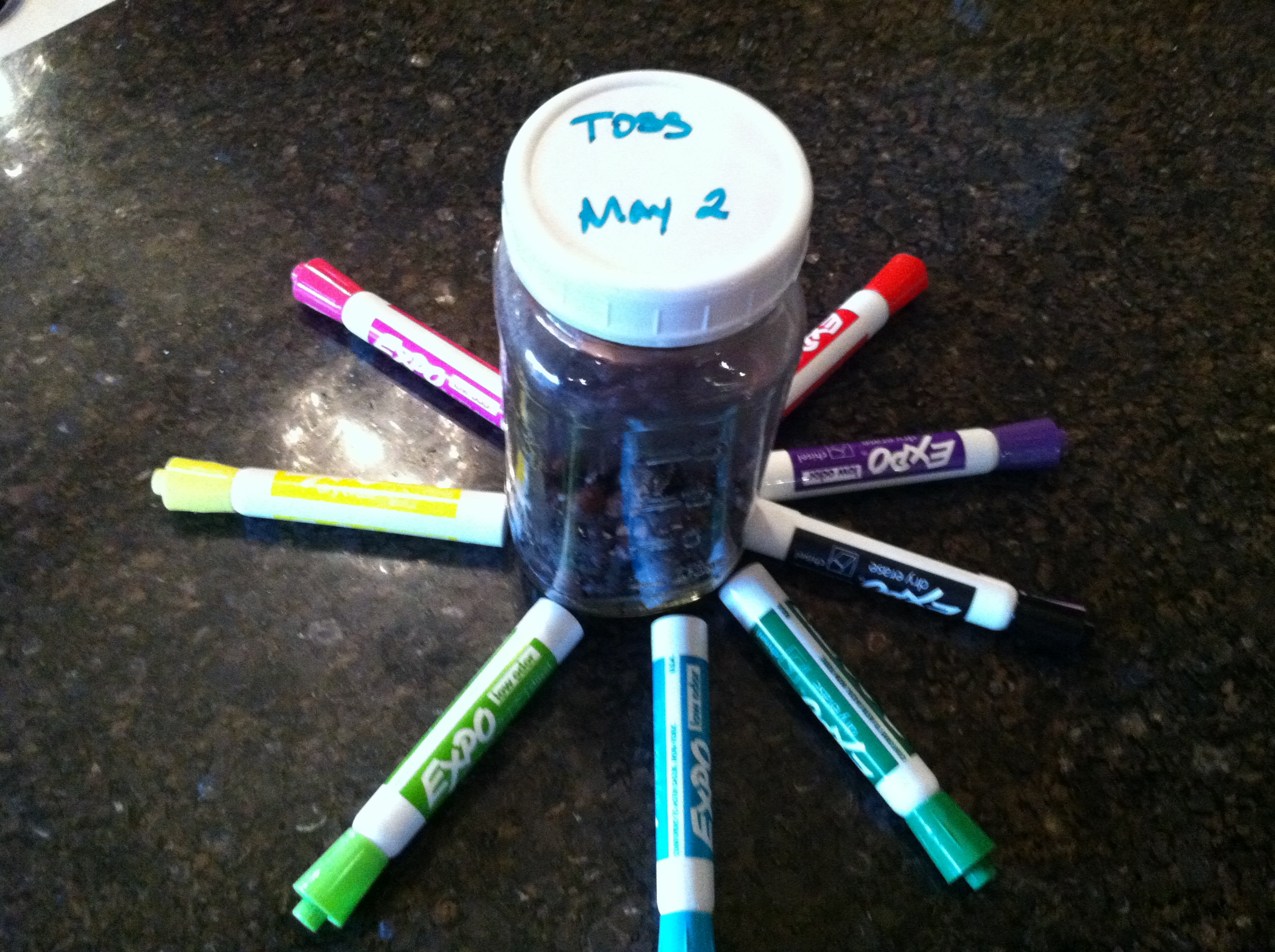
dry erase markers for food storage
Colorful & Reusable? Awesome

This week’s hack is something I’ve been thinking about for a while. A few months ago I wrote on a window with my dry erase markers, hoping they would wipe off of glass without an eraser or cleaner. They did, so I was looking forward to using them at our health food store when I purchased bulk items. All you have to do is tare the container as you walk in and write the weight on the jar or lid with your marker. Then, when you fill it, write the PLU on the top so the cashier can ring you up. My new store in Easton, PA doesn’t sell as much bulk as my old one (I’m heartbroken) and they don’t seem to use PLUs as much either. I haven’t tried weighing my containers yet, but I will next time I make the trip up there.

Oh, I try to write the throw away date on my leftovers, not the date I put it in the fridge. That’s a great tip for making it easier to know what’s good and what’s not that I learned from my Auntie Kim – she got it from her days in the restaurant biz. Thanks, Aunt Kim!

*Sidenote: Yes, those are the plastic mason jar lids. I’ve been putting off buying them for almost a year, but I kept thinking, “man, I wish I had some of those plastic lids…” so I finally caved and got 8 regular and 8 wide mouth lids. I have lots and lots of Classico lids which I use all the time on the regular mouth jars, but I didn’t want to “waste” my rings and lids for the wide mouth jars. So far I’m okay with my decision. They are BPA free and they never come in contact with the food – mainly used for fridge storage. We’ll see how long they last before they go the way of most of the other plastic in my kitchen… :0)

Send me your Homesteading Hack and maybe I’ll feature it on the blog!
Email ideas to owlmoonfarms {at} gmail.com

Homesteading Hack #2

I think of Homesteading Hacks as little tidbits of knowledge that can be used to make our homesteading experiences more enjoyable. Sometimes that means a hack saves us money, sometimes it saves us time, sometimes it does BOTH!

For instance, did you know Classico Pasta jars are Mason Jars?? Well, they are, and though you cannot re-seal them for canning with the Classico lids, you can use new lids/bands and process them just like any other jar! And, if you’re still to nervous to use them for canning, they make awesome storage for beans, rice and other dry goods. Plus, you can use the lids on any of your other Mason Jars for food storage/travel containers. So if you are buying pasta sauce from the grocery store, keep any eye out for Classico coupons and watch your weekly grocery store mailer and stock up! Think of it as buying pasta AND Mason Jars and the savings are even better!

nevermind the tacky temporary labels...

Send me your Homesteading Hack and maybe I’ll feature yours on the blog!
Email ideas to owlmoonfarms {at} gmail.com